iCarsoft JP V4.0 Review: Is It Worth More Than a Cheap Code Reader?
The JP V4.0 aims at Toyota, Honda, Nissan, Hyundai and Kia owners who have outgrown a basic reader. We went through its coverage, coding and resets to see what the extra money buys.
Spec sheet
- Our score
- 7.6/10
- Price
- $249.99
- Maker
- iCarsoft
- Tested
- Mar 29, 2026
Buy the JP V4.0 if you keep Japanese or Korean cars on the road and want ABS, airbag and transmission codes plus brake, throttle and battery resets without a shop visit. Skip it if you only ever need engine codes, because a cheap reader does that for far less. Treat the coding list as a bonus on Hyundai, Kia, Mazda and Subaru, not a promise.
Best forDIYers with Toyota, Honda, Nissan, Hyundai or Kia carsThe question with the JP V4.0 is simple: does a scanner for Asian-brand cars give you enough beyond a $30 Bluetooth dongle to justify $249.99? Our answer is yes for a specific kind of owner, and no for most people who only want to know why the check engine light is on.
We could not find an independent bench test of this model, so what follows rests on the maker's published documentation, the reseller listings, and a close read of the interface and function tables. Where a claim comes only from iCarsoft, we say so.
What a cheap reader cannot do
A basic code reader talks to the engine computer, and the better ones add ABS and airbag. That covers the warning-light question. It does not cover what happens after the repair: a new brake pad on a car with an electric parking brake needs the caliper retracted by command, and a new battery on many newer cars needs registering so the charging system stops overcharging it.
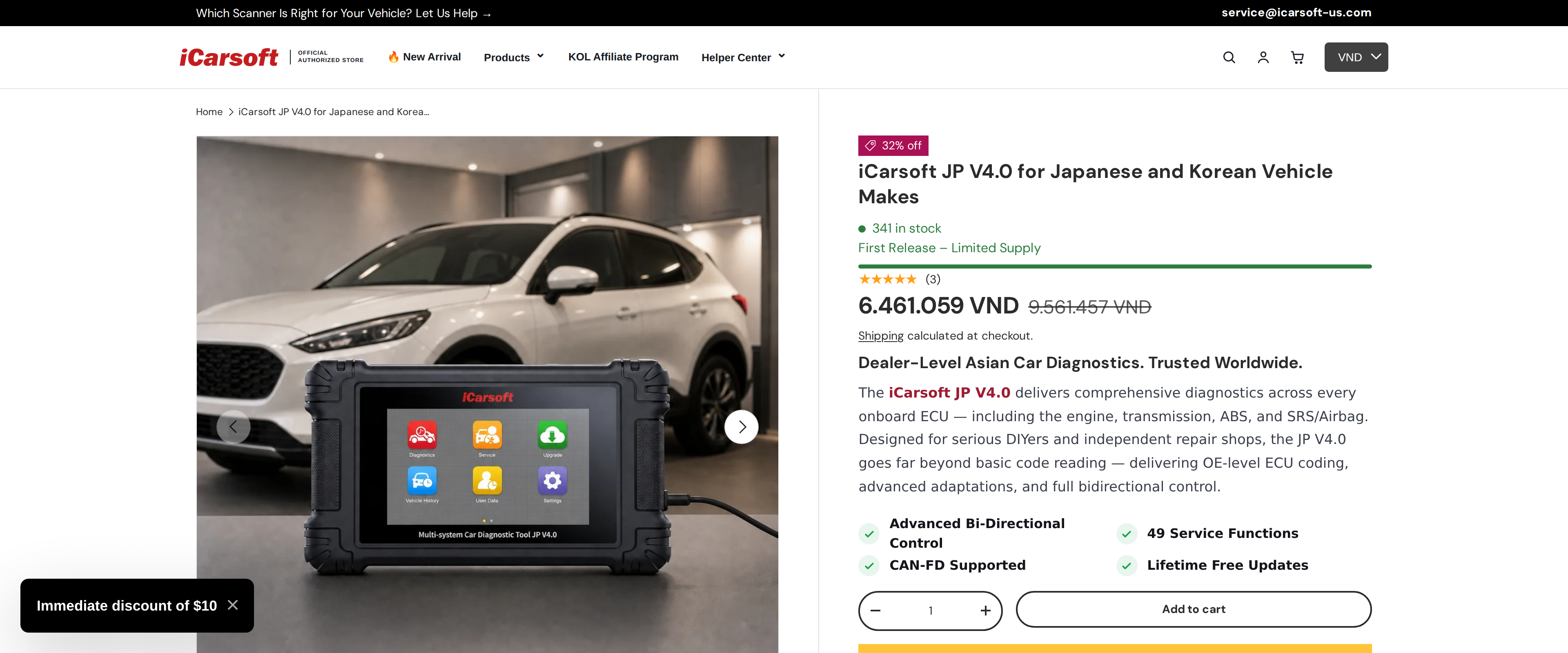
Those are the jobs the JP V4.0 is built for. iCarsoft lists 49 service functions, split into nine everyday resets (oil, throttle, parking brake, steering angle, DPF, injector, ABS bleeding, air suspension, battery management) and 40 advanced ones. The list is long, but availability changes by brand, model year and ECU, which iCarsoft admits in a notice on the page.
The commands are the real dividing line
Reading codes is passive. The JP V4.0 can also drive parts directly: cycle the ABS pump, run the window regulators, switch the cooling fans, open the throttle, cut or drive individual injectors. The maker's page counts 22 or more of these active tests.
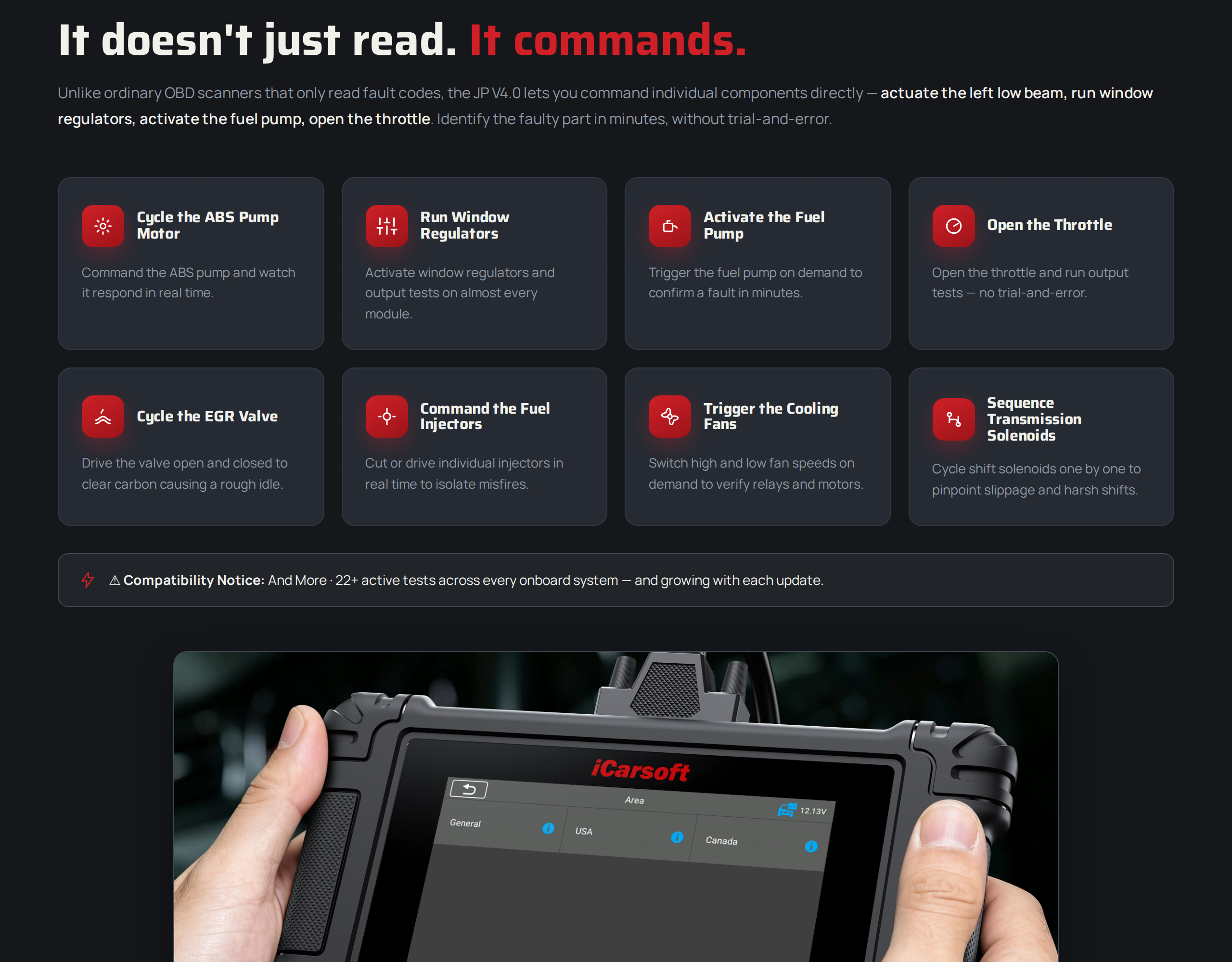
For a misfire or a stuck EGR valve, that is the difference between guessing and confirming. It is also where the tool earns its price against a reader, because you can prove a part dead before you buy its replacement.
Coding: real, but narrow
The page promotes ECU coding for four groups. Hyundai and Kia (2010 to present) get module matching and data backup, for example rewriting a new electric parking brake module's cluster, ABS and gearbox type. Mazda (2003 to 2020) gets hidden-function toggles such as auto-locking and chime volume. Subaru (2014 to present) gets lock-chime and auto-headlight settings.
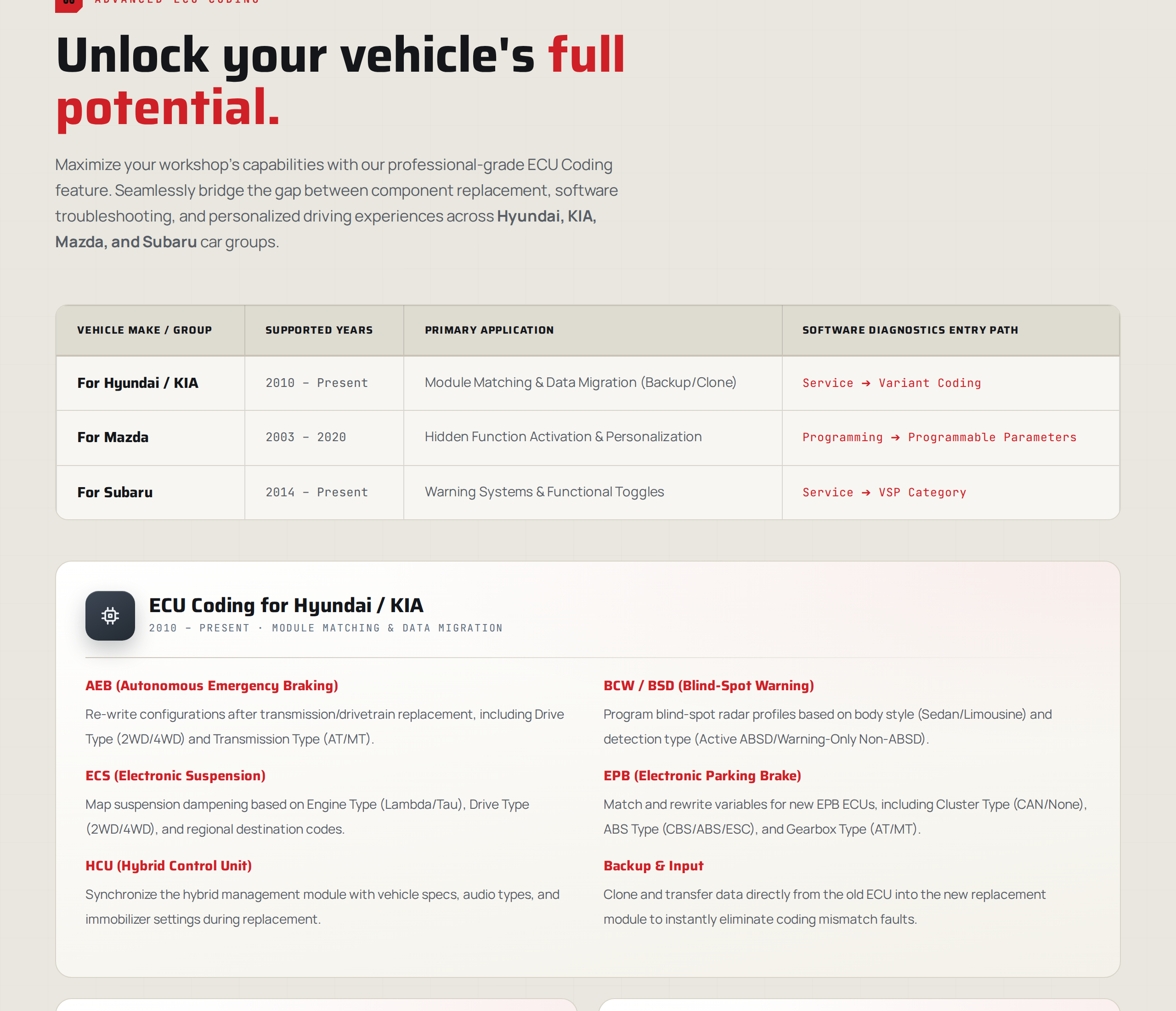
Toyota, Honda and Nissan owners are not on that list. If you drive one of those, you are buying diagnostics and resets, not customisation. iCarsoft says more brands will arrive through updates, which is a promise, not a feature.
Hardware that matches the job
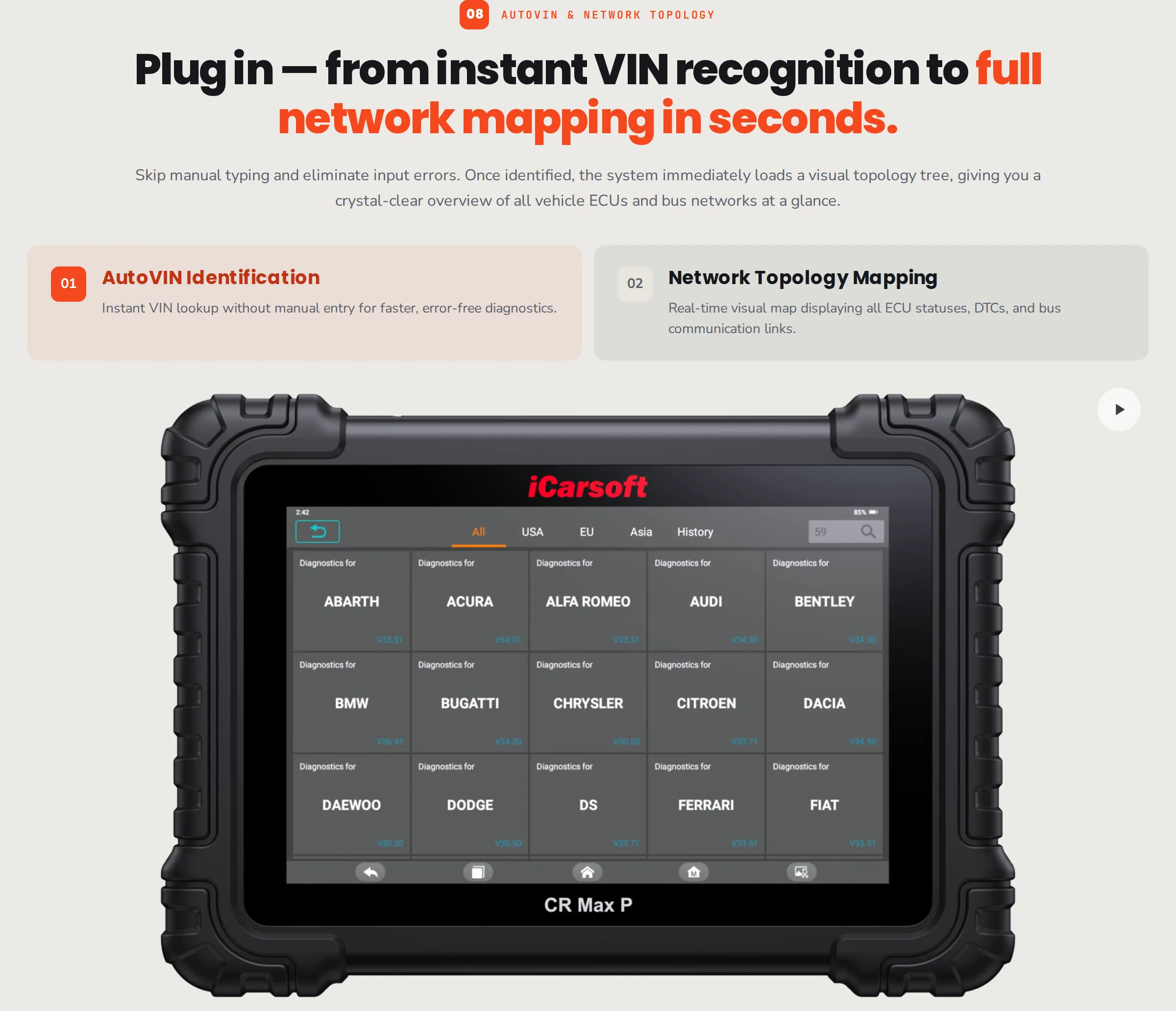
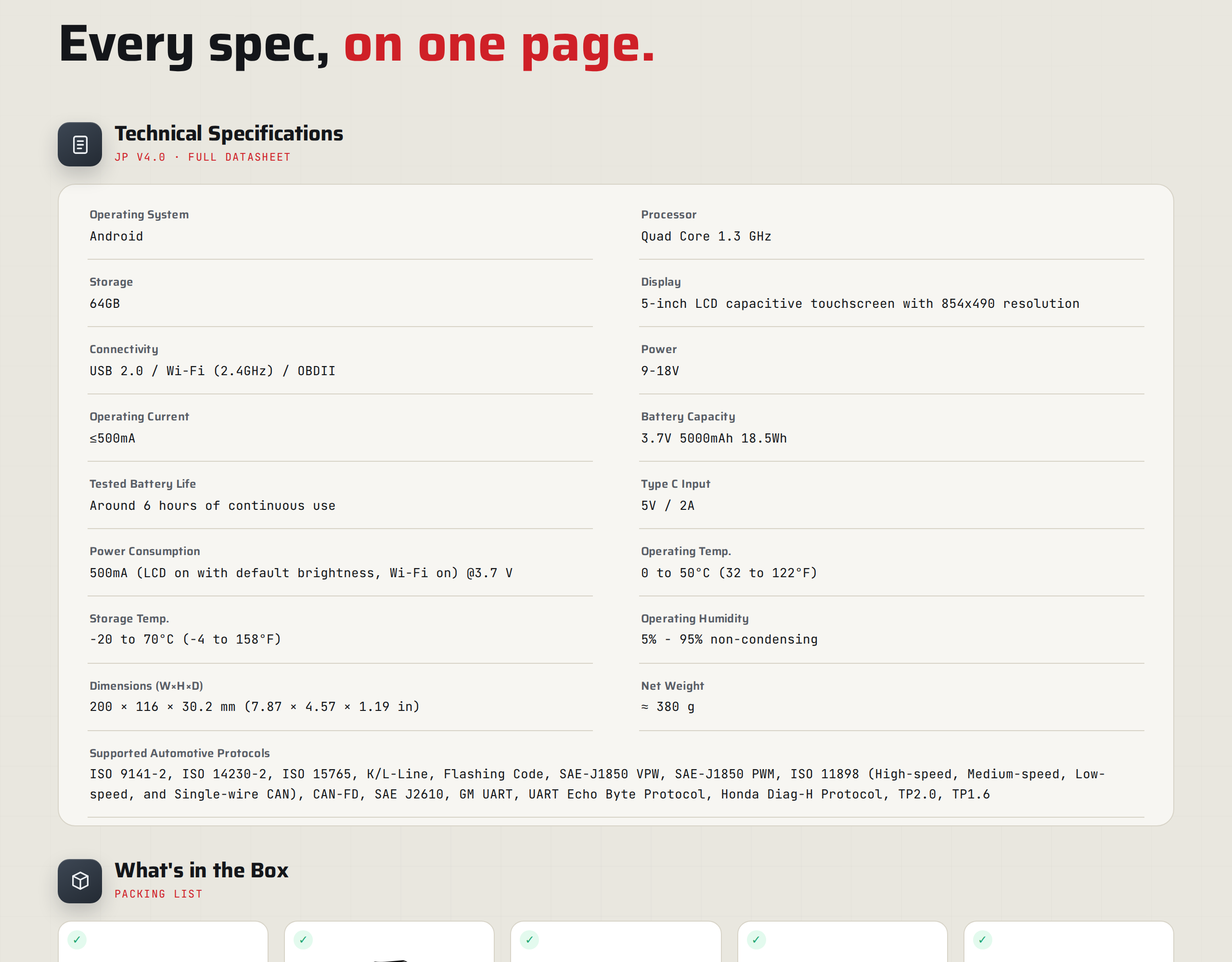
The unit is a 5-inch Android touchscreen with a 1.3 GHz quad-core processor and a 5000 mAh battery rated for about six hours. It weighs roughly 380 g and charges over USB-C. AutoVIN reads the car's identity when you plug in, so you skip typing a 17-character number, and if it fails you pick the car by hand.
One oddity: the spec sheet says 64GB of storage while the short table lower on the same page says 32GB. It does not change how you use the tool, but it is the kind of sloppiness that makes us read the rest with a pencil.
Against the older JP tools
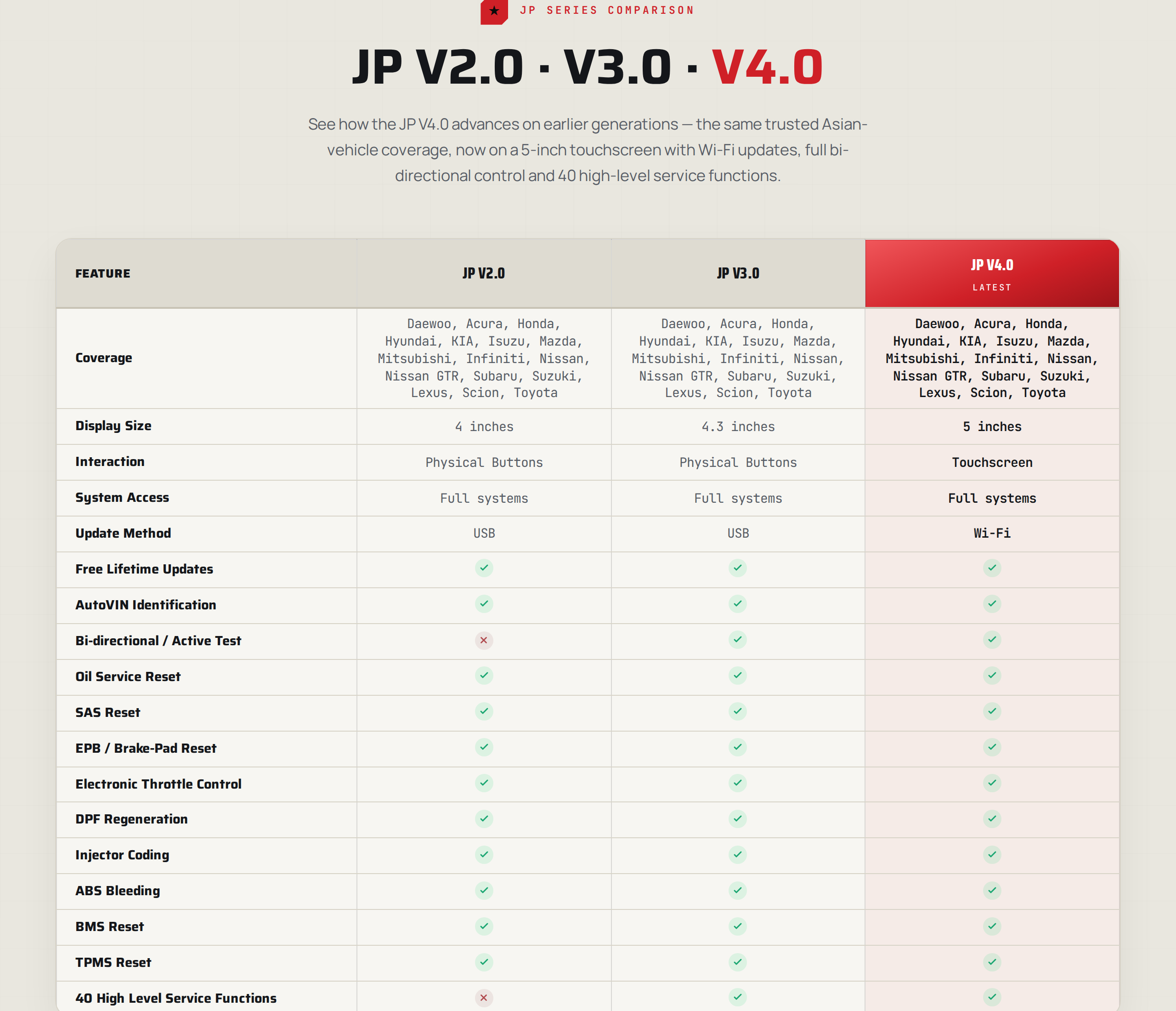
The earlier JP V3.0 uses physical buttons and updates by USB. The V4.0 moves to a touchscreen and Wi-Fi updates, and iCarsoft's own FAQ says the new model adds advanced ECU coding on top. The V3.0 has a 4.3-inch screen against the 5 inches here. If you can find a used V3.0 cheaper, check the table above for the functions you need before you buy.
Who should buy it
Buy it if you own two or three Japanese or Korean cars, do your own brakes and batteries, and want to see transmission and SRS codes before a shop does. A family with a Corolla, a Civic and a Sonata is the ideal home for it.
Spend less if your needs stop at engine codes. Spend more, on a multi-brand tablet, if you also touch Fords, Chevrolets or European cars, because the JP V4.0 will not speak to them.
Updates are free for life according to iCarsoft, which matters more here than on most tools because a database of Asian models only stays useful if it keeps growing. When we looked, the store listed the tool as backordered, so confirm stock before you plan a weekend around it.
What worked, what did not
Pros
- Reads and clears codes in every module, not just engine and ABS
- 49 service functions: 9 everyday resets plus 40 advanced ones
- Lifetime free updates over Wi-Fi, no subscription
- Variant coding and module matching for Hyundai, Kia, Mazda, Subaru
- Supports CAN-FD, the faster protocol on newer Asian cars
Cons
- Brand-locked: it does not cover Ford, GM or European cars
- Coding exists for only four brand groups, and Toyota is not one
- Maker's page contradicts itself on storage (32GB versus 64GB)
- Listed as backordered when we checked, so stock is uncertain
- No independent bench tests found, so depth is the maker's word
Specifications
- Coverage
- 16 makes incl. Toyota, Lexus, Honda, Acura, Nissan, Infiniti, Hyundai, Kia, Mazda, Subaru
- Display
- 5-inch capacitive touchscreen, Android
- Processor
- Quad-core 1.3 GHz
- Battery
- 5000 mAh, about 6 hours of use
- Service functions
- 49 (9 hot, 40 high-level)
- Protocols
- CAN, CAN-FD, DoIP, J1850, ISO 9141, K-line
- Updates
- Lifetime, free, over Wi-Fi
- Weight
- About 380 g
- Warranty
- 1 year